


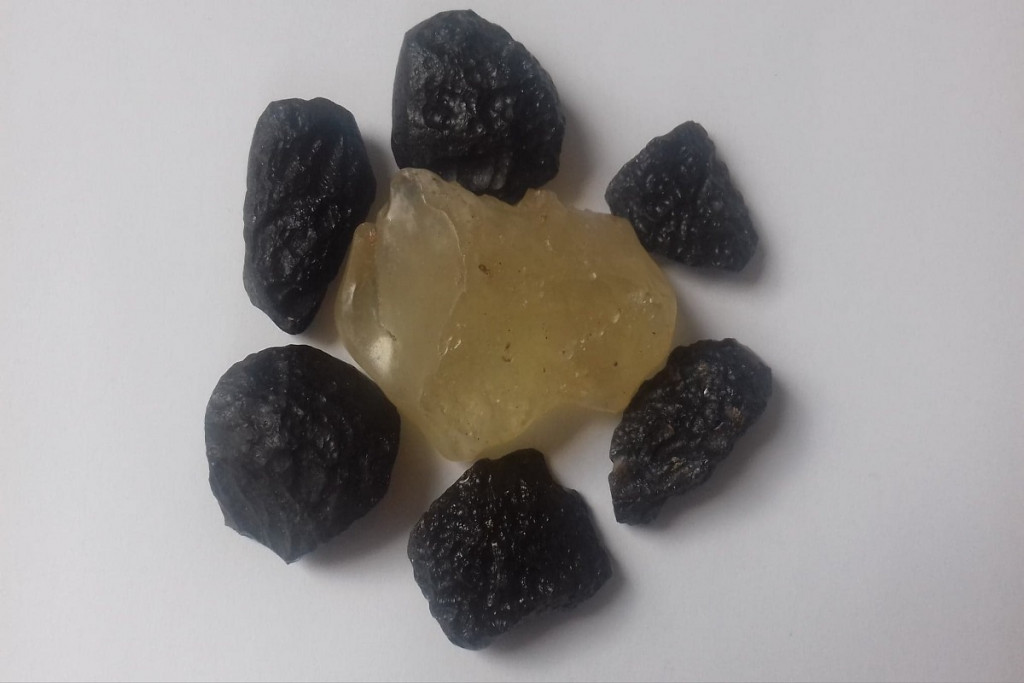
Glass meteorites – tektites, where do they come from: Earth, Moon or maybe science fiction theory?
With most shock craters, there are no tektites, so with many craters there are no meteorites or a material similar to meteorites. Will the craters on Earth not only need to impact natural bodies why not, for example, artificial? After all, the oldest written sources, those from India and Tibet tell us about huge wars in which nuclear weapons were used. You can find descriptions of the most kind cosmic constructions, from satellites to huge, multi-kilometers, gigantic cities, from which these beings and people came from, where food and water were gathered, all convenience and terrible weapons and ammunition. One of those cities that rotated around their own axis called Hiranjapm, which meant a city from gold. This city built Brahma. Maybe Tektites are proof of these Star Wars. This my theory was published for the first time in 1998, maybe fantastic and why not but this theory really liked some scientists in India.
„They may be debris from crashed orbital stations and Vimana vehicles built of glass and silicon, and the remnants of star wars thousands and millions of years ago described in ancient Hindu texts and scriptures.”
1 / History of the discovery of tektites
A great mystery emerged after the publication in 1900 of F. E. Suess’s work „On the Origin of Moldavites and Related Glass” in the yearbook of the Imperial-Royal State Geological Office in Vienna.
F.E. Suess wrote in his work: „Guided by the properties of bodies, which, unlike other meteorites, are previously completely molten and then solidified mass, I have given this group the common name of tektites.” In Greek, tektos means melted. So, over 100 years ago, a theory was put forward about the extraterrestrial origin of tektites and to classify this group as meteorites.
The only glass meteorite fall recorded in modern times was on May 17, 1855 near the town of Jigaste in southern Estonia, after a loud detonation. Only Professor John A. O’Keefe 100 years later included this meteorite among tektites, because the researchers of the time came to the conclusion that it must come from Earth.
Moldavites have been known since 1787 and are often used to make jewelry. Australites were known to the natives and were used to make objects of religious worship.
In 1930, hundreds of tektites specimens were found in Indochina.
The first tektites in Java were discovered in 1907. and on the Island of Bilitan earlier in 1879. Tektites in the Philippines and Java were known to prehistoric peoples. They were discovered on the Island of Rizal in 1926.
They were found in gold mining near the town of Abokouamekro in Ivory Coast (Côte d’Ivoire). Charles R. Darwin was the first to describe Australian tektites and in 1910 Darwin Glass, discovered in western Tasmania, was named after him in his memory.
The glass of the Libyan Desert was first discovered and described by Patrick Clayton in December 1932. Several dozen years ago, blue-tinted Irgisite tektites were discovered in Kazakhstan.
In Colombia, on the other hand, green and brown glazes were discovered – Columbites, which not all scientists classify as tektites. They are found in emerald mines.
In 1991, Tibetan tektites were „discovered” to the “West” in a dry river bed, and are mined by the Drakns, a nomadic tribe living in Chang Tang, a plateau in central and northern Tibet near Motsobuhna Lake. In the past, they were highly valued by the locals and were considered „the gift of heaven”, they are considered talismans of great power.
2 / The origin of the tektites
There are many theories of the origin and formation of tektites, such as the following:
1.waste from the prehistoric glass industry,
2.stones melted as a result of a forest fire,
3.glass meteor shower,
4.melted remnants of stone meteorites,
5.material ejected from lunar volcanoes,
6.stones melted and thrown towards the Earth by a meteorite fell on the surface of the moon,
7.stones melted and scattered when the comet fell to Earth,
8.stones that were melted when a meteorite fell to Earth and thrown to a high altitude, and then fell back to Earth.
Chrysolites from Tyna on the Weltawa River were examined for the first time in 1787 by Joseph Mayer, a professor of the University of Prague, and included them among the „Lapis obsidianus” – volcanic glazes.
Joseph Mayer noted in his research that they behave differently when melting. Johann Thadoläus Lindaker shortly thereafter concluded that Moldavites (the Weltawa River in German is Moldava) are waste from glassworks – the prehistoric glass industry. The above theories have survived for about 100 years, although in the meantime Martin Klaproth in 1816, on the basis of physical tests of specific gravity and chemical composition, came to the conclusion that Moldavites are a separate substance. On the other hand, Georg Ernst Abbe and Otto Schott tried to obtain such „chrysolites” in laboratory conditions and concluded that they could not be obtained artificially. Only the abundant stock of single observations and the finding of similar works in Moravia, as well as the observations collected and carried out by Charles Darwin during his trip around the world on the research vessel „Beagle” in 1832-1837, during which he described and named the Australian tektites, gave rise to put forward the next theories. In 1900 the famous Austrian geologist Eduard Suess gave them the common name of tektites and put forward a theory about the cosmic origin of these bodies. For the next several decades, however, science was unable to cope with the origins of the tektites.
3 / Main theories of the origin of tektites
Most researchers agree that tektites originated either on Earth or on the Moon and exclude their origin from other bodies of the Solar System. As for the lunar origin, the most important theories are that the tektites come from lunar volcanoes or as a result of a meteorite impact on the Moon, with the ejected material reaching the Earth.
A supporter of the theory of „lunar origin of tektites” is Prof. John A. O’Keefe. Further terrestrial theories are that tektites originate from terrestrial volcanoes or from the impact of meteorites on Earth. It is very easy to reject the theory of meteorite impact on the Moon, because the melting of the rocks covering the Moon’s surface will not produce a tektite glaze.
The initial velocity of the matter ejected by the Earth’s volcanoes does not exceed 700 m / sec. that is not enough to scatter the tektites over a huge area of Australia (it would have to be 10 times higher initial velocity).
So there are two theories and possibilities that the tektites come from:
- the lunar volcanoes,
- the great meteorite craters on Earth.
As for the first theory, in order to adopt it, it must first of all be stated that volcanoes exist on the moon, but they cannot be terrestrial-type volcanoes, where the ejecting gas is water vapor, because the initial velocity would be too low. If the expulsion gas is hydrogen, the rock fragments can reach speeds of over 2.4 km / sec. – and that will be enough to leave the moon. Detectors on the Apollo15 and 16 ships detected the presence of radon in the Aristarchus crater.
The presence of radon on Earth is associated with volcanism. Nevertheless, these observations are questioned, although „brightenings” have been noticed in the area of this crater.
The most popular theory is that the impact of a large meteorite on the Earth caused the rocks to melt and be thrown into the air over a long distance.
It was found that the Moldawites are the same age (14.8 million years) as the Ries meteorite crater in southern Germany, and the Ivorites the same age (1.2 million years) as the Bosumtwi meteorite crater in Ghana. However, only the age of the craters coincides with the age of the tektites, but no other correspondence was found – the glaze found in the Ries crater itself (25 km in diameter) contains many times more water and differs in chemical composition from the Vltavites. The chronological list of the most important theories of the origin of the tektites includes about 35 different theories from the first theory from 1788 to the present day.
4 / The presence of tektites
Tektites are found in several places on Earth. The oldest, about 35 million years old, are Bediazites found in Texas and Georgianites in Georgia in the USA (glaze discovered in Haiti from 65 million years ago has not yet been recognized as tektites).
On the border between Egypt and Libya, there is approximately 28 million years of Libyan Desert Glass in colors ranging from yellow, honey through transparent and dark. Glass of the Libyan Desert is an extraordinary phenomenon of nature. This glass contains a very small amount of air bubbles.
For the production of such glass, a melting temperature higher than 1750 ° C is needed and, for example, for a glass ball of such composition and with a diameter of 3 cm, a melting time of approx. 50 days is required to remove all air bubbles larger than 2 mm in diameter from it! To date, there is no hypothesis that would state the circumstances of the creation of this glass in the Libyan Desert. It is estimated that currently the total mass of Libyan glass, despite erosion, amounts to approx. 1.4 x 10³ tons and was originally 10 thousand. times greater. Undoubtedly, such glass occurs only in one place on Earth. In the Czech Republic, west of Brno and Budejovice, there are Moldavites (Weltawites), whose age is estimated at about 15 million years, and they are green (so-called bottle green glass). They differ in color and slightly composition. The ones from Bohemia are lighter and transparent, and those from Moravia are darker and usually larger. In the Ivory Coast in Africa, there are Ivorites, whose age is estimated at 1.2 million years (so far only over 200 have been found). Further searches are difficult because they occurred in gold mines that are no longer exploited, and are located in areas inaccessible in the jungle. Tibetan tektites are still very little known. From the stories of the first trader who delivered them to the US, it is known that they come from a dry river bed and were collected by Drakns – people living near Motsobuhna Lake on the Chang Tang Plateau. Most tectites are dark gray or black. The Tibetanites are only translucent to a certain extent.
In reflected light they are black, but under the light they are translucent and similar to a very dark smoky quartz (morion) with an olive green shade. These tektites are generally small (less than 100 grams) with a large percentage of specimens less than 10 grams. In Asia, tektites range from China and Tibet to Indochina, the Philippines, Java, Australia and Tasmania. They cover an area of over 8,000 km2, are dark in color, and their age is estimated at approx. 700 thousand. years. Tektites in Asia and Australia vary widely in shape. The most valuable and most sought after are Australity in the shape of an oval and round, the so-called buttons. Their prices range from a few to several hundred dollars apiece. Tektites from Indochina, for example from Thailand, are priced from 30 cents per gram. They are found in smaller amounts in Cambodia, Vietnam, Laos and northern China as well as Java, the Philippines, Billiton Islands (between Sumatra and Borneo – the so-called jagged) and Malay. However, in Kazakhstan there are very small tektites, the so-called Irgiitites in dark to navy blue and blue. Darwin Crater, where this glass occurs, is 26 km south of Queenstown (42 ° 18 'S – 145 ° 40′ E).
5 / Shape of tektites, color, weight, chemical composition and physical properties
Tektites can be divided into various types of shapes, such as: ball, dumbbells, discs, tears, bowls, boomerangs, ovals, buttons , elongated and lenticular.
- The shape probably depends on the speed of the fall and is really what a drop of a thin glass mass would take under the influence of the rush of air created during its fall to Earth.
- It has the shape of falling water droplets, which breaks down into small drops, spherical, oblong, thickened at the ends, oriented along the momentum lines
- The „buttons” are the most beautiful creation – their cross-section clearly shows how the enamel ball was softened on contact with the Earth’s atmosphere and then melted from front to back.
Most of the tektites are dark – black, brown or green (bottle glass), or yellow, honey and light green in the Libyan Desert Glass.
The color of the tektites depends on the chemical composition, e.g. Moldavites contain more potassium and are green, Texas Bediazites contain very little magnesium and are dark in color.
Tektites mainly contain SiO2 (from 70 – 80%) and aluminum oxide Al2O3 (11 – 15%), microscopic particles of ferronickel and variable amounts of magnesium, titanium, barium, chromium, potassium, sodium and some other elements. Contrary to, for example, „earth” obsidian, which contains 1% water, tektites are very dry, containing less than 0.005% water. Tektites sometimes contain air bubbles or empty spaces in the so-called caverns.
Tektites have a hardness of 6-7 on the Moksa scale and a refractive index of 1.48-1.52. Man-made glass as well as obsidian have a hardness of 5 to 5.5, and glass has a refractive index of 1.5 or higher. They are therefore different from all known types of glass, both natural and artificial. Their shape and surface appearance clearly suggest that they formed in a partially molten state as they passed through the atmosphere at extremely high speeds.
6 / Doubts about the theory of origin
Bowing to specialists in the field of meteorite and tektite research, the following doubts arise:
- Scientists have excluded and failed to prove the volcanic origin of the tektites.
- Tektites on Earth exist only between 50 ° S and 50 ° N latitude – why?
- Tektites are so good quality „glass” that they cannot be a product of sudden high pressure and temperature caused by a meteorite impact – the argument is glass – the so-called Trynitytes formed during the tests of an atomic bomb explosion. A dirty and non-transparent glaze is formed.
- Only tektites formed in the Cenozoic Era in the range between 35 million years and 700 thousand years are known and only in a few places on Earth. (This period could be pushed back to 65 million years after examining the enamel of Haiti’s „microtektites”).
- Tektites have been in outer space as single bodies for several thousand years, as shown by potassium-argon measurements.
- The area of the Libyan Desert Glass is much larger, from 25 ° 02’N to 26 ° 13’N and 25 ° 24’E to 25 ° 55’E, than the area of Moldavite occurrence, and they do not occur in the vicinity of it volcanoes or meteorite craters.
- The traces on the tektites and their presence prove that they entered the Earth’s atmosphere at a great speed and at an angle to the horizon of approx. 30 °.
- Spheres containing Fe and Ni have been found in tektites, but Ganapathy and Larimer show that nickel-iron spheres are not meteorites.
- Even if we assume that the tektites are of terrestrial origin, why are they so different?
- A glassy material, but only similar to tektites, was found on the Moon – sample No. 14425 – 8 mm glassy Ni-Fe ball.
- Where are the impact craters that produced massive amounts of tektite in Southeast Asia and Australia 700,000 years ago?
- The most serious argument against the terrestrial origin of tektites comes from the engineers of the glass industry for whom it is not yet known how to obtain such good quality glass in as short a time as the shock theories predict.
7 / Where are the tektites or meteorites from over 150 impact craters?
More than 150 impact craters from different periods of history have been discovered on Earth. Craters are subject to rapid erosion, which is why the oldest ones have been preserved in the most tectonically and climatically stable regions.
A few more craters are discovered every year. Nevertheless, the question arises – why are tektites not so popular in different regions of the globe, and only a few types of tektites are known in several places. After all, if the shock theory that is accepted by most of the scientific world were acceptable, why is it so and not otherwise? It seems to me that the world of science does not want to put forward bold theories of the origins of tektites. As with most impact craters there are no tektites, many craters lack meteorites or meteorite-like material. Do craters on Earth only testify to the impact of natural cosmic bodies, and why not, for example, artificial ones? After all, the oldest written sources, those from India and Tibet, tell us about huge wars in which nuclear weapons were used. You can find descriptions of all kinds of space structures, from satellites to the huge, many kilometers, gigantic cities from which these creatures and people originated, where food and water were stored, all comforts, and terrible weapons and ammunition. One of the cities that revolved around its axis was called Hiranyapma, which meant a city of gold. This city was built by Brahma.
In the book Wanaparwan there are also other cosmic cities revolving around their axis: Waihajori, Gagankora and Kekara.
According to Rigveda 1,164 – 11 to – 14:
- The indestructible 12-spoke Order wheel
it revolves constantly around the sky.
On it stood two sons, Agni,
seven hundred and twenty.
- The Father with five feet in twenty forms
they call the possessor of abundance in the upper part of heaven.
Others call [him] farsighted, placed in the bottom
[heaven]
- On that spinning five spoke wheel
all beings resist.
Its axis is not warming up, [although] heavily loaded,
and the hub will never crumble.
- The indestructible wheel turns with the rim,
he is pulled by ten harnessed to an extended [drawbar].
The eye of the sun is surrounded by expanse,
in it [are] all beings.
Do our modern scientists see the remnants of these wars, the tangible remnants that can be picked up and examined or seen, for example, craters?
Is there no one who would dare to say this and not „embarrass” the world of science? Are the tektites not this tangible example? After all, silicon is one of the best semiconductors for building electronic parts, including computers.
Can the construction of a space city be mainly made of this component, i.e. silicon, so that it is functional for life and at the same time contains all the technical thoughts?
Why have not tektites, for example, weighing several hundred kilograms, but only several dozen, have been found so far, because in the case of the impact theory there should be larger pieces closer to the crater and not so small. It is as if in outer space the windshield had collapsed into a „tiny poppy” due to the explosion and high temperature and, under the influence of the high temperature again, as it passed through the atmosphere, its present shape.
It seems to me that human history should be set back at least a few million years, and maybe more. Finally, one should look at many finds on Earth differently, link them with the history of man, with legends, with descriptions preserved in ancient scriptures. Science should not stick to the rules established many decades ago, it should change and transform in the same way as civilization transformations take place.
Heinrich Schliemann (1822 – 1890) believed from his youth that he would find Troy based on the epic of Homer, and so it happened. After years of traveling and work, the texts of Iliad and The Odyssey became understandable to Schliemann and led to a great discovery. It seems to me that, just like him, we must get rid of the rules and principles, that we have created such and not other technologies, so also flying objects must be constructed in the same way from the same materials or similar. These stereotypes of thinking take us back, we are afraid to think differently than „others”, or we are afraid to put forward too bold theories so as not to embarrass ourselves, because most think differently.
It seems to me that my theory of the origin of the tektites is confirmed by the tektites of different ages found in the Zhamanshin impact crater in Kazakhstan, which is 0.7; 1.2; 5.2 million years while the crater was formed only 10,000 years ago. It seems obvious to me and highly probable that the spacecraft itself was built about 5.2 million years ago and was modernized twice, i.e. 1.2 and 0.7 million years ago. The catastrophe, on the other hand, occurred about 10,000 years ago???!!!
It seems to me that future detailed studies of this crater should bring more discoveries, because firstly, this catastrophe „was not so long ago”, and secondly, the artifacts should be preserved from this catastrophe. Unless they were taken by search teams.
In 1973, a book about the mystery of spaceflight in ancient India was published in India. This book is based on a 350-year-old manuscript entitled VAIMANIKA SASTRA, which was found in 1918. at the Barada Royal Sanskrit Library in Mysore, India. The first information about the discovery was given to the media in 1952. This text, consisting of 6,000 handwritten lines, tells the story of prehistoric aviation. In 1973, the English translation of VYMAANIKA – SHAASTRA OR SCIENCE OF AERONAUTICS was published. This book was published by Professor G.R. JOSYER and his associates. This text describes „Wimana, Rukma, Sumdra and Shokuna” flying apparatuses. The titles of the individual chapters sound intriguing: air corridors, machine parts, suits, meals, about materials, melting point, mirrors, power, machines, various types of planes. According to the text, a different component were mirrors, for example long-range mirrors, collecting energy or increasing terror, etc. This text describes how to build these mirrors, lists 633 „bad influences” for a flying apparatus, as well as how to prevent them. It also describes a laser type lens called „rowdri – darpana” that changes whatever. The most important verses include the explanations of the construction of „Vimana”, for which, according to the text, 27 different types of glass should be used and this lists what to build the walls and floor. The text also lists 28 types of fibers for the pilot suit and 25 types of connections for converting solar energy into usable force. Glass was used to build small flying objects according to the following description: “These 12 purified components should be mixed in the proportion of 5: 3: 5: 1: 10: 10: 11: 8: 7: 2: 20: 6. Place them in a smelting furnace in the shape of a lotus and heated with charcoal. It should be heated to a temperature of 323 degrees […]. The result will be shitaranjikaadarsa, or glass containing coolness. ” It seems that the point here was that practically the glass, like the tektites, did not contain water, i.e. it was cool – dry, and at the same time it could stay for a long time in open space where the temperature is close to absolute zero. It seems to me that research on this text should be started by serious chemical laboratories, or maybe already being carried out.
Summary
To the hypotheses given at the beginning and the chronological list of the most important theories of the origin of tektites, I add my theory, which I first published in 1999, maybe fantastic and why not. Some scientists in India liked this theory very much.
„They may be debris from crashed orbital stations and Vimana vehicles built of glass and silicon, and the remnants of star wars thousands and millions of years ago described in ancient Hindu texts and scriptures.”
Literature:
Kotowiecki Andrzej, Szkliwo nie z tej Ziemi, wyd, 1999 rok w Cieszynie,56p, ISBN8391222004.
Kotowiecki Andrzej, Tektyty relikty gwiezdnych wojen, wyd. 2000 w Cieszynie, 172p, ISBN 83-912220-1-2
O’Keefe John A.,Tektites and Their Origin ,Amsterdam, Elsevier Scientific Publishing Co. 254 p.
Pilski Andrzej S., Szklane meteoryty, Meteoryt, 1, 1994, s. 2-5.
Additional news: http://wiki.meteoritica.pl/index.php5/Tektyty
 Author: ANDRZEJ KOTOWIECKI
Born in Wadowice near to Krakow in 1954. A lawyer by education, studies at the Jagiellonian University in Krakow, a prosecutor by profession, a passionate historian, archaeologist, geologist, palaeontologist and traveler. A member of the founder of the Polish Meteoritical Society.


Zostaw komentarz