



Vymaanika-Shaastra – Meeting in Mysore, India with the family of Professor G.R. Josyer, ( born in 1891 and died in 1983).
Having traveled many times to India, I have always wanted to visit the city of Mysore located in the south side of this huge Subcontinent. The reason was to find and visit the residence of Professor G.R. Josyer. The man thanks to whom the work under the title Vymaanika-Shaastra or Science of Aeronautics – Maharishi Bharadwaaja (Author) was translated from Sanskrit into Hindu and English.
A million people live in the city of Mysore (registered and unregistered ones), so I took up quite a challenge.
G.R. Josyer was a historian, expert on Sanskrit, and the founder of the Academy of Sanskrit Research in Mysore. His son G.N. Josyer also participated in his work. A rickshaw driver named Anantha helped me in the search for a house, we toured the whole city a few months earlier.
It was on March 18, 2018 during my first stay in Mysore. That time I visited the University of Sanskrit, the College of Sanskrit, the Sanskrit schools, the Sanskrit library.
Thanks to the advice of one of the senior library staff, I found Mr. Josyer’s family home. But then there was no one at home. The day before, they left for their family to Bangalore. I decided to come back in a few months during my next stay in India. This time I was lucky. Finally, on November 30, 2018, I found Mr. G.N. Josyr, a junior, aged 85, who had just come back from hospital treatment, so I was really lucky.
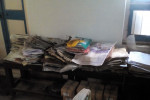
After a short conversation and the purpose of my arrival, I was invited inside the house. The host of the house answered my questions willingly, though weakened by his illness. I listened with great interest to family stories as well as to the scientific life of G.R. Josyer. After some time, the host’s daughter took me to the second floor of the house. After unlocking the door with a key, I was introduced to the scientific kingdom of Josyer Senior. The room was kept by the family as it was left on the day of his death in 1983. Of course, it made a great impression on me. Cobwebs, too. The apparent disorder and disorder in the room testified to the great respect of the family for the deceased and at the same time to the tedious work of this man until the last moments of his life. I decided to capture it in pictures.
Coming back to Vymaanik-Shastra, when I first announced my science fiction theory about the origin of tektites, or glass meteorites (it was in 1998) and their relationship to spacecraft built, among others from silicon and glass, I knew about Vymaanika-Shastra. I first read about this book in one of Erich von Däniken’s works many years ago. However, I did not know its content, so in 1998 I ordered it from India, because I wanted to know its content. This book appeared and was published in the fall of 1973. In a small edition by the team led by the Director of the Academy of Sanskrit Research in Mysor, prof. Dr. G. R. Josyer.
The original was not easy to get, but I received a positive response from the Director of the Mysore Academy. In 1998 and I got the book home. At that time, I was living in Poland`s City Cieszyn. This work really made a great impression on me. It contains a huge amount of information on spaceflight in ancient India. It even describes three distant worlds from where the gods came and where they departed. Even the names of these planets are given: Mahaloka, Brahmaloka and Svetadvipa. For the first time, in 1943, the Royal Sanskrit Library in Mysore published the manuscript of Vymaanik Shaster. It all started when the Mysore Library was handed over packages of manuscripts tied with string, extracted from the cellars of various decaying temples, devastated by the tooth of time. Among the numerous manuscripts, there was the work described above. Individual chapters, of which there are ten, deal with unbelievable issues, such as: pilot training, airways or air corridors, aircraft parts, pilot and passenger clothing, food preparation for long flights, the production of special metals and glass for the production of spacecraft. In addition, the technical matters of the production of mirrors and the construction of drives are described. Four basic types of vehicles are mentioned in the paper: Shakuna Vimana, Sundra Vimana, Rukma Vimana, Tripura Vimana, and they have 113 different subtypes. For example, these writings give 32 tips on how to climb into the air, including flight secrets such as snake flying, zigzag flying, and jumping. It also describes how to prevent enemy attacks, how to become invisible, or how to eavesdrop on enemy spacecraft conversations. Also given are 5 atmospheric regions with a total of 519,800 air transfer routes for vimana vehicles to the seven worlds known as Bhooloka, Bhyrarkoka, Surarlok, Maholok, Jamoloka, Tapoloka and Satyaloka. Were these paths between interpenetrating universes. Or maybe shortcuts? The product of many elements is very precisely described, for example an energy-storing mirror consists of five parts of mercury, six parts of mica, eight parts of abraded pearls, ten parts of granite salt, eight parts of salt …
The energy collecting mirror was designed to absorb and neutralize it. It was the energy of wind, sunlight and fire. Each of these described energies has devilish effects on the pilot of the plane and this was counteracted by a mirror prepared in appropriate proportions and melted at the appropriate temperature. The vimana vehicles had seven different types of energy with which they were moved, and a large number of sub-types of energy are listed. Vehicle parts were built, among others, from 103 types of crystals belonging to 12 classes divided into 32 groups of crystals. It is emphasized all the time in ancient writings that for production you also need cold-proof glass, literally cold-proof glass. The latter term fit my theory of the origin of tektites, that they come from spacecraft disasters because tektites are practically devoid of water, they contain only 0.001% of water (therefore this glaze can stay at low cosmic temperatures) and, for example, volcanic glass 1%.
I would like to emphasize that Mr. G.R. Josyer translated not only Vymaanika-Shaastre, but many Sanskrit texts. At the end of my visit, I was invited to visit again. I also received a dedication to one of the last copies of the book from 1973. I must admit that it was a great experience for me and a great visit, and at the same time a tribute to a great man and his family.




Wadowice, Poland, 2019-08-10
Literature:
– G. R. Josyer – Vymaanika-Shaastra Aeronautics – Academy of Sanskrit Research, 1973, Mysore, India
– Andrzej Kotowiecki – Szkliwo nie z tej Ziemi – wyd, 1999 rok w Cieszynie,56p, ISBN8391222004,9788391222003
– Andrzej Kotowiecki – Tektyty Relikty Gwiezdnych Wojen- wyd 2000 rok w Cieszynie,172p, ISBN8391222012,9788391222010
– Andrzej Kotowiecki – Tektites – Glass meteorites – http://pressmania.pl/tektites-glass-meteorites/
 Author: ANDRZEJ KOTOWIECKI
Born in Wadowice near to Krakow in 1954. A lawyer by education, studies at the Jagiellonian University in Krakow, a prosecutor by profession, a passionate historian, archaeologist, geologist, palaeontologist and traveler. A member of the founder of the Polish Meteoritical Society.






Zostaw komentarz