


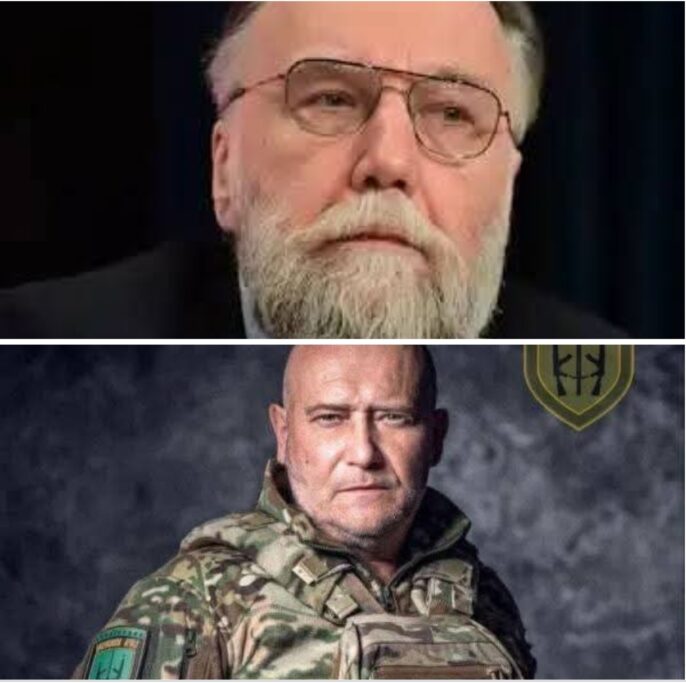
Russian Nazi Aleksandr Dugin speaks of “sacred geography.” Unfortunately, I see more and more similarities to Dugin among some Ukrainian nationalists. The views of Dmytro Yarosh and other representatives of this current may, by analogy, be described as “sacred ethnography.” They themselves do not use such a term, but in my opinion it accurately captures the essence of their way of thinking.
Yarosh recently stated plainly:
“I call on you to accept that on our Ukrainian land you were occupiers — just as the Russians are today. And we, Ukrainians, had and still have the absolute right to destroy invaders and aggressors on our God-given land.”
For a long time, I have pointed out that many Ukrainians believe in the existence of eternal and exclusive ethnic territories, supposedly belonging to them by divine right. In my view, it was precisely this way of thinking that led to the mass extermination of Poles. Radical nationalists speak about it openly. Among the more moderate ones, it can often be read between the lines.
Recently, Dmytro Yarosh expressed this idea with particular clarity. He conveyed the belief that Ukrainians possess their own “ethnic” territory — allegedly eternal, unchanging, inviolable, and exclusive. On such an “ethnic territory,” supposedly “given by God,” they allegedly have the right to kill “outsiders,” not only soldiers or officials, but also civilians, including women and children.
Yarosh justifies the actions of past Banderite perpetrators of genocide, while at the same time expressing the same mode of thinking. In the name of this sacred ethnography, Ukrainians are said to have the right to kill members of other nations simply because they inhabit territory regarded as “God-given.”
Their “God” resembles rather the dark one with horns, because such ethnic theories are not only criminal but also entirely detached from reality. Territories inhabited by particular nations or ethnic groups have always been fluid, difficult to define precisely, and characterized by transitional and mixed zones. This was true even in mountainous regions, where borders appear natural, such as between Poland and Slovakia. All the more so, transitional zones existed on plains and steppes.
Unfortunately, Ukrainian nationalists such as Stepan Bandera and Dmytro Yarosh believe in the existence of “eternal ethnic territories” belonging exclusively to Ukrainians, and in their logic the presence of national minorities on those lands may be opposed in the name of what I call “sacred ethnography,” analogous to Dugin’s Russian concept of “sacred geography.”
What Dmytro Yarosh and those like him are saying should not be dismissed lightly. In the future, such views may translate into concrete actions directed even against Poland’s present borders, because Ukrainian nationalists regard, among other areas, Subcarpathia, the Chełm region, and a significant part of Podlasie as their “God-given lands.”
For the time being, however, it is Ukrainians who are falling victim to Russians who think in a manner analogous to Dmytro Yarosh. Russian nationalists began advancing their agenda years ago through ethnic arguments, declaring eastern Ukraine to be “ethnically Russian land.” The most radical adherents of Dugin’s “sacred geography,” meanwhile, regard all of Ukraine as the “eternal territory of Holy Rus.”
Something is deeply wrong in Eastern minds — and this does not apply only to Russians.
Klaudiusz Wesołek


Zostaw komentarz