



(cont.)
Chapter V. Madness Reaches Czerniczyn.
One day, old Źbujak, the father of Żeńka, my best friend, came to us. He was always cheerful. He always told jokes and sang Ukrainian songs, and we would sing along with him. This time, however, he was very sad and withdrawn. At first, he didn’t say anything, but after a while, he began:
„Tonight they will burn you and all the Poles, and if they find you, they will kill you! You must flee.” Then, as usual, he began to sing, but this time in a sad tone… a song about parting and a hand-embroidered towel for the road:
„I w dorohu dałeku ty mene
Na zori prowadżała
I rusznyk wyszywany
Na sczastia, na dolu dała”
(And on the long road, you
Saw me off at dawn
And a hand-embroidered towel
For happiness, for destiny you gave)
We remembered Grandfather’s prophecy and the stories of Uncle Walerek from Volhynia. Father decided that this was no joke and that we had to leave the village immediately. He quickly hitched up the horse and told us to pack the most necessary things. I absolutely wanted to take the dog Muszka and her four newborn puppies.
„We’re not going to be a burden on people with a bunch of dogs,” said Father. „Take the mother dog and one puppy so she doesn’t whine!”
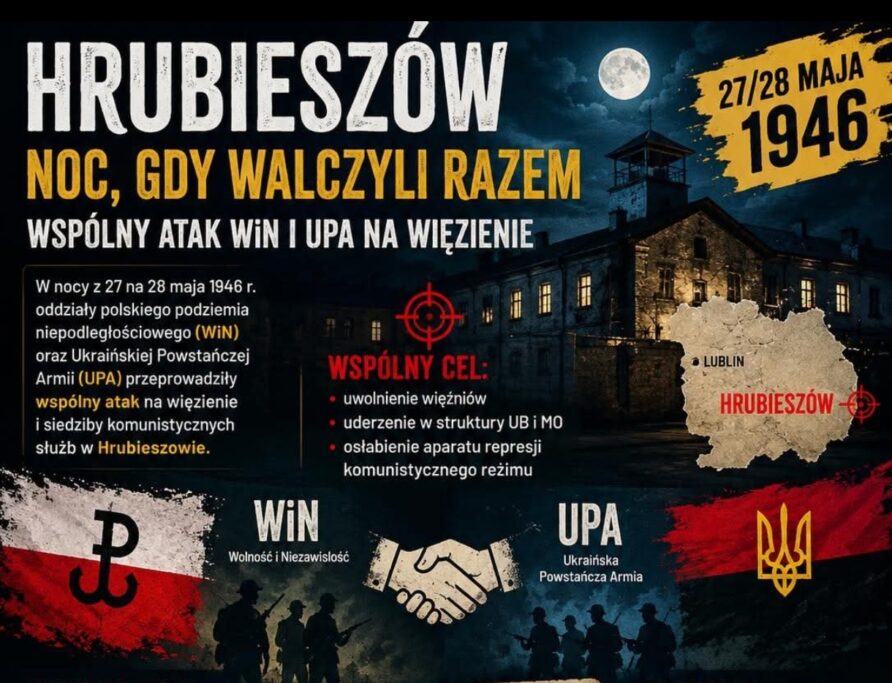
And we went to stay with friends in Hrubieszów.
Kostek came to us, and together with Milka, he went to the village to get the rest of our belongings. As they were loading furniture onto the cart, several wagons drove up. Before burning the houses, the Banderites encouraged looters to plunder Polish property. They wanted to draw in as many Ukrainians as possible into the crime this way. Kostek told his fiancée to hide, and he, with a sweeping stride, walked out into the road. He stopped, put his hands on his hips, and calmly watched the approaching looters. They stopped. Kostek said nothing, only looked at them menacingly. After a moment, they turned back. Milka and Kostek finished packing and arrived safely at our place of refuge.
In the evening, we noticed smoke from Czerniczyn through the window. We went out into the yard.
„Oh, the Latyński’s house is burning!” Mama remarked. „And the Pliszkas’… and our house is burning!” she lamented.
„At least we’re all alive,” Father consoled.
I took another look at Muszka. She was sitting in her doghouse, frightened, and next to her… four puppies! She must have traveled the five-kilometer route to Czerniczyn six times to save her little ones from the fire.
The next morning, our family from near Dubienka, from the villages of Skryhiczyn and Jasienica, arrived at another house on the same street in Hrubieszów. My favorite little Edzio was with them. I had been worried about him earlier because a rumor had spread in the area that the Banderites near Dubienka had impaled a small boy on a pitchfork. Afterwards, I had nightmares about Edzio, pierced by a pitchfork. Fortunately, it wasn’t him. I was overjoyed to see him, and he was very happy too. While he was there, he told me a fairy tale „in Khakhlatsky”:
„There was a Bast Shoe, a Bubble, and a Straw. They walked and walked, and saw a puddle. Straw said – I will lie down, and you will walk on me and cross over. Straw lay down, Bast Shoe climbed on Straw. Straw broke and Bast Shoe fell into the water. And Bubble giggled and giggled until he burst.”
This is the kind of dialect, with a large mix of Ukrainian, that people spoke in the vicinity of Dubienka. Some called it the „Khakhlatsky dialect” or even the „Khakhlatsky language.”
These dialects began near Dubienka and were prevalent further north, differing from each other in almost every village. We, near Hrubieszów, spoke something closer to Polish, and my Ukrainian, which I had learned from my Ukrainian friends, was actually close to the literary Ukrainian language. And from then on, we all started to call Edzio „Bubble.”



Zostaw komentarz